
The clock-face analogy is a highly effective tool for analyzing the dynamic forces, velocity shifts, and acceleration phases interacting during high-performance carving turns.
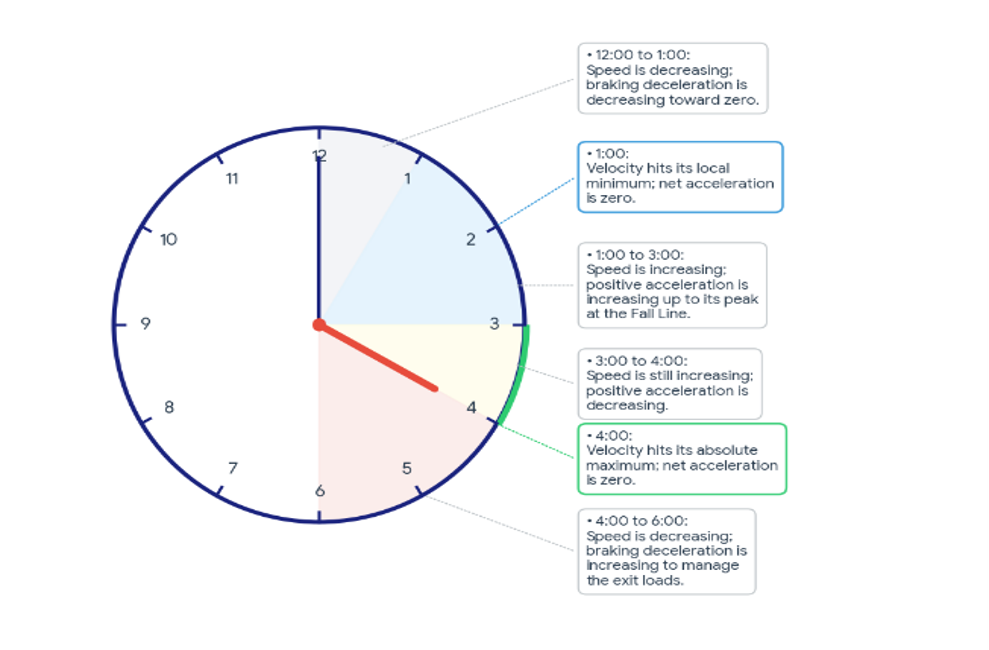
To maintain a consistent, runner-centric framework, we utilize a continuous relative clock face that resets at every transition point. For a right-hand turn, 12 o’clock represents the initiation/edge change (Inflexion Point), 3 o’clock is the fall line pointing straight down the slope, and 6 o’clock marks the completion of the turn (the next inflection point). For the subsequent left-hand turn, the clock face mirrors: 12 o’clock initiates the turn, 9 o’clock represents the fall line, and 6 o’clock completes the cycle.
1. Dynamic Phases and Critical Points
- From 12:00 to 1:00 (The Transition Window):
The skier executes a direct edge change at the 12:00 inflection point. During this brief window, the skier experiences decreasing deceleration. The braking forces carried over from the previous turn drop off rapidly as the skis release pressure. At 1:00 there is the absolute minimum velocity of the turn where net acceleration momentarily crosses zero. - From 1:00 to 3:00 (The Gravity Acceleration Zone):
Once past 1:00, the skier enters a phase of increasing positive acceleration. Driven by the propulsive component of gravity, the skis accelerate rapidly toward the fall line. To counter the resulting backward inertial force, the skier must proactively project their Center of Mass (CoM) forward and inside the turn. Acceleration reaches its absolute peak value at 3:00 (The Fall Line), where the slope inclination relative to the skis is maximized. - From 3:00 to approximately 4:00 (The Velocity Peak Window):
After crossing the fall line, the forward pull of gravity begins to shrink as the skis steer across the hill, but it still outpaces external resistance. This creates a brief zone of decreasing positive acceleration. Speed continues to increase until the skier reaches the dynamic apex around 3:30/4:00. At this point, absolute maximum velocity is achieved because net acceleration drops to exactly zero. - From 3:30/4:00 to 6:00 (The Heavy Loading and Braking Zone):
Past the dynamic apex, the combination of rising edge friction, mechanical snow deformation, and aerodynamic drag overpowers the decaying gravity vector. The skier enters increasing deceleration, generating an inertial force in the direction of travel. This braking force pushes the skier’s body forward, requiring active leg compression and progressive load management to control the pressure before resetting the clock at the next 12:00 transition.
2. The Blueprint of the Clock-Face Zones
- 12:00 to 1:00: Speed is decreasing; braking deceleration is decreasing toward zero, generating an inertial force in the direction of travel, which decreases in intensity.
- 1:00: Velocity hits its local minimum; net acceleration is zero.
- 1:00 to 3:00: Speed is increasing; positive acceleration is increasing up to its peak at the Fall Line, generating an inertial force opposite to the direction of travel, which increases in intensity.
- 3:00 to 3:30/4:00: Speed is still increasing; positive acceleration is decreasing, generating an inertial force opposite to the direction of travel, which decreases in intensity.
- 3:30/4:00: Velocity hits its absolute maximum; net acceleration is zero.
- 3:30/4:00 to 6:00: Speed is decreasing; braking deceleration is increasing to manage the exit loads, generating an inertial force in the direction of travel, which increases in intensity.
In classical Newtonian mechanics, inertial forces are “fictitious” or “pseudo-forces” that only appear because the skier is an observer inside an accelerating, non-inertial reference frame (the turning skis). In biomechanics, however, this force is entirely real to the skier’s muscles; it is the exact force the skeletal system must manage, redirect, and absorb to maintain stability.
3. Theoretical Calculus vs. Tactical Reality
In a purely theoretical calculus model—assuming an idealized carved semicircle on ice—velocity would peak around 3.30/4:00 (the dynamic apex), where the geometric vectors of the turn dictate that net acceleration crosses zero.
However, the tactical reality of non-stivoting turns of Giant Slalom course warps this theoretical symmetry:
- Kinetic Shearing Friction: Turning a ski aggressively across the hill introduces massive lateral loads. The edge carves a deep furrow into the snow, creating high mechanical displacement and kinetic friction that arrests speed.
- High-G Radius Manipulation: Racers routinely utilize a variable or “dirty” radius. They run a straighter, cleaner line through the upper fall line to build speed, followed by a sharp, sudden contraction of the turn radius right at the gate. This sudden contraction triggers an instantaneous spike in centripetal resistance, acting as an aggressive brake.
- Quadratic Aerodynamic Drag: Air resistance scales quadratically with velocity. At elite GS speeds, aerodynamic drag acts as a massive decelerator.
The Dynamic Apex: The Worst Moment of a Turn
The Dynamic Apex is labeled “the worst possible moment” because it represents a critical mechanical crisis where physics forces a severe tactical tradeoff. In high-level skiing, this specific moment introduces two massive penalties that actively threaten a racer’s speed and line control:
1. High Velocity Collides with a Shrinking Radius
The mathematical equation for centrifugal force is Fc = (m * v²) / r, where Fc is the centrifugal force pushing the skier outward, m is the skier’s mass, v is their velocity, and r is the radius of the turn.
- The Numerator (v²): Because velocity peaks late in the turn (approaching the dynamic apex around 4:00), the numerator is at its absolute maximum.
- The Denominator (r): At this exact point, the skier must shape the bottom half of the turn and set up the next line, meaning the turn radius (r) must aggressively tighten. While a constant radius would conserve pure linear speed, tactical skiing requires the racer to shape a tighter bottom-half arc to clear the gate cleanly and immediately direct their skis toward the next gate’s line.
When the highest velocity squared (v²) forces its way into the tightest arc (r), the resulting pressure spike is not linear—it is exponential. The skier is slammed by a sudden, massive spike in G-force that can buckle their skeletal structure if they are caught off guard.
2. The Direction of the Force Acts as a Brake
The geometry of the turn at this point (around 3:30 to 4:00 on the clock face) means the skier’s line of travel is no longer running down the hill; they are tracking across the slope.
- Energy Destruction: The massive centrifugal force generated here does not push the skier down the course. Instead, it drives the ski edges laterally and deeply into the snow.
- The Speed Trap: This deep edge penetration creates immense mechanical shearing friction against the snow matrix. If the peak velocity occurs here, this massive force acts as a dead brake, actively destroying the speed the skier worked so hard to accumulate down the fall line.
The Tactical Verdict
It is the “worst” moment because the physics of the turn are working entirely against the skier’s objective. The mountain is using the skier’s own maximum speed to force a heavy braking tax right before the transition. Elite skiers must build an incredibly rigid platform to survive this specific geometric bottleneck without letting their skis stall out.
Conclusion
While the theoretical model places zero net force and maximum velocity around 4:00, racing environmental forces drag the net acceleration vector down to zero much earlier. Due to the immediate onset of heavy edge resistance and drag after the fall line, the absolute velocity peak in tactical skiing is pulled backward, topping out between 3:15 and 3:30 on the clock face. By the time the racer reaches the theoretical 4:00 position, they are ready to exchange fighting their own inertia for taking advantage of it, using the massive platform resistance to launch into the next gate.
Note: This article is based on the “Teoría de la Técnica” manual published by AADIDESS.
