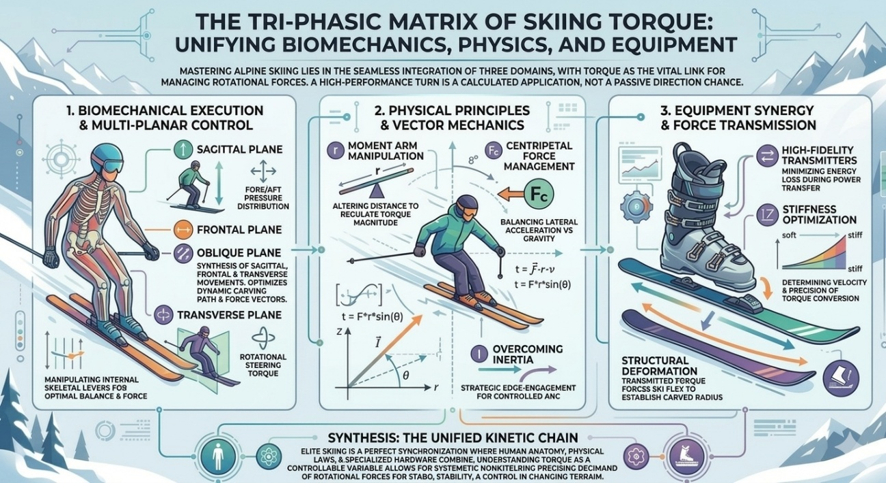
The mastery of alpine skiing lies in the seamless integration of biomechanics, physics, and equipment to manage rotational forces. Torque serves as the vital link connecting these three domains. A high-performance turn is not a passive change in direction, but a highly calculated application of rotational mechanics.
1. Biomechanical Execution & Multi-Planar Control
Skiers manipulate internal skeletal levers across the four anatomical planes to optimize balance and force generation:
- Sagittal Plane: controls fore/aft pressure distribution to keep the center of mass pinned over the sweet spot of the ski.
- Frontal Plane: governs lateral edging angles, dictating how deeply the ski penetrates the snow surface.
- Transverse Plane: initiates rotational steering torque through the hips and femurs to guide the skis into the line of the turn.
- Oblique Plane: the oblique plane in skiing is the real-world blend of all three anatomical movements happening at once. Balance, edging, and steering combine along the oblique plane to create a singular, effective carving motion.
2. Physical Principles & Vector Mechanics
Biomechanical inputs translate directly into external Newtonian vector quantities that combat environmental constraints:
- Moment Arm Manipulation: altering the distance between the center of mass and the snow surface regulates the magnitude of rotational torque.
- Centripetal Force Management: balancing lateral acceleration against gravitational pull prevents the skier from low-siding or high-siding.
- Overcoming Inertia: strategic edge-engagement breaks linear momentum, forcing the skier’s mass into a controlled arc.
3. Equipment Synergy & Force Transmission
The mechanical interface acts as an amplifier and translator of human intent into snow displacement:
- High-Fidelity Transmitters: Ski boots act as rigid conduits, minimizing energy loss during lateral and forward power transfer.
- Stiffness Optimization: Proper boot flex determines the exact velocity and precision of torque conversion.
- Structural Deformation: Transmitted torque forces the ski’s sidecut to flex against the snow, establishing the geometry of the carved turn radius.
Synthesis: The Unified Kinetic Chain
Ultimately, elite alpine skiing is defined by a unified kinetic chain where human anatomy, physical laws, and specialized hardware function in perfect synchronization. By understanding torque as a controllable variable rather than an unstable byproduct, skiers can systematically isolate performance bottlenecks. Whether adjusting a joint angle in the frontal plane or modifying the flex profile of a boot, every variable serves a single objective: the precise command of rotational forces to maximize speed, stability, and control across changing terrain.
Final Conclusion
In summary, a high-performance turn is not merely a change in direction, but a calculated application of torque where the body’s levers and the equipment’s mechanics work in harmony to control the dynamic forces of our motions.